Pipkin and the Last Line
On Halloween, the town library breathes.
It’s a soft thing—you don’t notice if you’re talking, if you’re laughing, if you’re counting the candy you swear you didn’t eat yet. But if you stand on the cracked steps of the old printworks where the library moved after the flood, you can feel it: a hush that exhales cold over your knuckles and draws the night a little closer. I keep the keys now. Someone has to. Someone has to make sure the bindings don’t unspool and the dead stories don’t forget themselves.
At 10:11 p.m., while the cul-de-sac hollered at a skeleton dog that turned out to be a very alive corgi in a hoodie, I unlocked the lobby and sniffed the air the way I always do. Paper, dust, and something sweet—like melted sugar left too close to a candle.
That was new.
I followed the sweetness through Periodicals, past the moon-silvered photocopier that only prints blank pages on Halloween, and into Children’s—where the aisles are lower, the shadows are kinder, and the floor creaks like polite applause. There, near a display of pumpkin books that had all quietly arranged themselves by scariness, I met him.
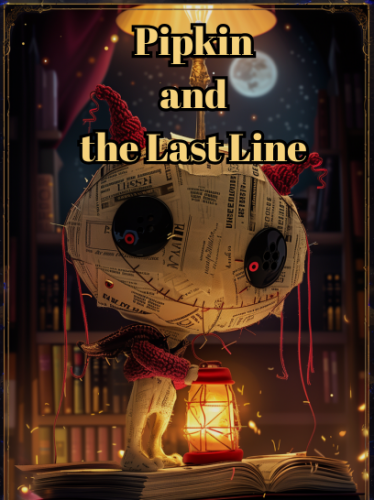
He popped his head up from a picture book and froze at the sight of me: a very small ghost with a sheet made from old checkout slips. The slips were stitched together with red thread and stamped with years of due dates. Two shiny black buttons were sewn on for eyes. He had little candy-corn horns crocheted to his hood and a mouth that looked like it had been drawn with charcoal, then erased, then drawn again. He held a lollipop like a lantern.
If you’ve ever seen a dust bunny decide it has a soul—if you’ve seen a teacup think about screaming—if you’ve seen a child’s lost mitten turn around—then you know the feeling. It wasn’t fear. It was the feeling of the night that decided we were going to be honest with each other.
“Hi,” I said, because you should always say hi to anything made of story.
The little ghost squeaked and dropped into the book, so only the lollipop and the tops of his candy horns were visible. A beat later, he rose again in the deliberate way of someone practicing bravery.
“I’m not supposed to talk to librarians,” he whispered. His voice wasn’t a voice. It was the sound of turning a page.
“Good,” I said. “I’m not a very good one.”
He thought about that, then drifted a cautious inch closer. He smelled like sugar skulls and cold ink. A gum wrapper clung to his trailing edge.
“What’s your name?” I asked.
He gnawed on the lollipop stick. “I… I’ve had a lot. Boo. Button. Baby Bat. Picking one is like choosing your favorite marshmallow in the bag. But tonight I’m Pipkin.”
“Of course you are,” I said, because the night loves when you agree with it. “Why does the library smell like a candy drawer?”
Pipkin’s button eyes flicked toward the ceiling. The lights hummed. The printworks sighed. From somewhere out on Bellwether Street, a cheer rose and fell like a wave—someone got a king-size bar, or saw something they weren’t ready to see.
Pipkin leaned in. “Because something is hungry,” he breathed. “And it doesn’t eat what people eat.”
“Books?” I asked, already feeling protective.
“Endings,” Pipkin said, and shivered. His sheet crinkled like old paper. “It comes every time the leaves go sharp. It smells the last lines. If it swallows them, stories can’t finish, and then they can’t find their way back next year, and then the world forgets how to be brave because how do you practice if you never hear how the brave part goes?”
He pointed his lollipop at a book display: The Last Pumpkin Walk. I knew that book. An old town tale: lanterns in the fog, a promise, a safe return. On the shelf, every copy had a torn corner at the back. Their last page was missing.
“I was trying to hold them,” Pipkin said, small and ashamed. “But I’m only a little monster ghost. And it’s bigger this year.”
“What is?”
Pipkin swallowed. You could see the path the lollipop took as it vanished into storytelling logic. “The Hollow. It’s the part of the night that’s missing its face. It can’t scare you on purpose; it scares you by taking away the part of the story that tells you what the fear was for.”
The library breathed out again. A draft spiraled around our ankles like a cat deciding whether to forgive. Somewhere deep in the Archives, something metallic clicked—one of the old presses turning itself by a notch.
“Show me,” I said.
We went back through Reference, where the atlases had quietly slid open to maps of the town as it was, as it will be, and as it remembers itself being. Pipkin drifted at my side, leaving a faint trail of glittering sugar, which I didn’t point out because dignity matters even if you’re only three feet and made of paper.
We descended the iron stairs into the basement. The typesetters slept there: cumbersome, beautiful machines with levers like ribs and trays of letters organized into tiny cities of meaning. The sugar scent was stronger here. Pipkin frowned. “It’s learning. It knows where words are born.”
At the far wall, something glimmered like gasoline on water. The Hollow was not a shadow. Shadows know what they belong to. This was an unclaiming. It was an absence, bright around the edges with a color your eyes refuse to name. As we watched, an invisible mouth pulled letters out of a tray—first the capital T’s, then the more nervous lower-case ones—each little sound gulped like a cough you don’t want anyone to hear.
“Hey,” I said, because you can say hey even to cosmic hunger. It turned. You can’t look at something that doesn’t have a face, but it looked back anyway. The room cooled over the years. The damp on the brick glittered like salt.
Pipkin bobbed, tiny fists in the air. “You can’t have them!” he squeaked. “Not the last lines.”
The Hollow breathed in.
Rows of type whispered toward it, dragged by the invisible undertow. Letters rattled, skittered, leaped, the way leaves leap when a truck rushes by. Pipkin yelped, whipped off his candy-corn horns, and flung them like boomerangs. They struck the air and stuck there with a small, righteous sound, pinning the emptiness for one, two, three beats.
“Run,” Pipkin said, and that was bravery.
We ran, which is to say I ran and Pipkin whizzed. The Hollow surged after us, not fast, just inevitable like a deadline. Up the stairs. Through Biography. Past a display of Edgar Allan Poe that rearranged itself into cheerier authors as we passed, as if embarrassed to be on-brand. The lights flickered. The photocopier burped out a page with one sentence written in sugar dust:
He gave the lantern to the smallest ghost.
We skidded to a stop so abruptly I left part of my shoe sole on the tile.
“That’s the last line,” I said. My breath came out in white questions.
“It’s one of them,” Pipkin whispered. “They’re different every year, but they rhyme. This is the one that rhymes with me.”
The Hollow slid along the ceiling, erasing the buttery light. It made the world feel like the breath you hold when a story turns a corner. The lobby door rattled. Outside, the last trick-or-treaters began to head home, glitter smeared, makeup cracked, all of them full of hours they’d never quite be able to explain. Midnight was walking toward us on thin heels.
We needed a lantern.
“Stay here,” I told Pipkin, and sprinted for the display case near the desk. Every Halloween, the printworks hosts a little museum of oddities: a lead slug that reads HELP ME (typesetters’ joke), a whisper jar corked with black wax, a paper moth with text for wings. And a lantern, iron-framed, old glass rippled like pond water. It’s supposed to be decorative. But stories have a way of checking out anything they need.
I smashed the case with the heel of my hand, wickedly satisfying. The lantern was cold and heavier than it looked. It didn’t have a candle.
“Hold it,” I told Pipkin, shoving it into his paper arms. “I’ll find a light.”
He shook his head. “It doesn’t take that kind.”
The Hollow poured down the stairs, erasing the bottom step, then the next. When it reached us, there would be no last lines, no first ones either, just the long middle of being afraid with no moral to carry you through.
“What kind then?”
Pipkin’s voice was just a rustle now. “The kind you make when you choose the ending you want.”
Sometimes the town gives you a sentence, and sometimes it stares at you until you write one.
“Okay,” I said. “Okay.”
I put my hand on the lantern and thought about all the last lines I’ve loved. The brave go out into the dark. The lost is found and finds herself different. The monster curls up by the fire and is not alone. I thought about the way Halloween lets you try on fear like a coat while your real self watches from the mirror and says, You’re doing great.
The glass fogged with our breath. The iron warmed. Pipkin watched me like kids watch fireworks. The Hollow drew near enough that I could hear its not-breathing: a pressure on the eardrums that wanted to flatten them like stamps.
“Here,” I said, and I meant the sentence. “Here is the lantern for the smallest ghost.”
The lantern lit.
Not with fire. With punctuation. Commas like tiny moths fluttered inside, a steady pulse of and then, and then, and then. A single period settled into the base like a coal, full stop, and full comfort. The light was soft as library lamps after hours.
Pipkin swelled. His button eyes shone. His stitched mouth opened wider than a child’s drawing should allow, and rows of harmless, paper-cut teeth unfolded like lace. He didn’t become uglier when he turned monstrous; he became truer. The Hollow reared back, which is a trick for something that is an absence, but fear can make you learn shapes you didn’t know you had.
Pipkin stepped forward, lantern held out. He did not chase. He did not scold. He let the light show the Hollow what it lacked: an ending that chose kindness. The Hollow shuddered, rattled the windows, pulled like a tide with nowhere to go. Then—because even hunger obeys a good story—it broke around Pipkin like dark water breaking around a small rock, and it drained away down the stairs, back into the place inside the world where we keep our almosts.
The library breathed in. The light steadied. In Children’s, the torn pages stitched themselves along the fold with a whisper and the smell of hot sugar. Outside, the last porch light clicked off.
Pipkin’s shoulders drooped in relief. He looked smaller again, and very tired, and very pleased in the quiet way of someone who did the right thing even though he was shaking.
“Keep it,” I said, pushing the lantern back into his arms when he tried to hand it over. “Last lines need a keeper.”
“Just for tonight,” he said. “I only get to keep anything if someone gives it to me.”
“I’m giving it to you.”
He smiled. It was mostly thread, but I’ve never seen anything brighter. “Then I’ll bring it back next year. And the year after. If you leave me a wrapper so I know you finished your candy.”
“I’ll leave two.”
Pipkin floated a little higher. “Greedy.”
“Hungry,” I corrected.
He giggled, a soft rippling sound that sent the atlases flipping through to the future and pausing hopefully. Then he tucked the lantern into his sheet, adjusted his candy-corn horns, and drifted backward into a picture book, where the color deepened like a held breath. His lollipop reappeared in his hand as if it had never been eaten. That’s the nice thing about stories. Snacks reset.
“Good night,” I said.
“Good ending,” he said.
If tonight, when the house is dark and the wrappers crinkle under your pillow because you forgot to throw them away, you hear a tiny knock under your bed and feel a little cooler at your ankles—don’t be afraid. That’s just Pipkin. He’s making sure your last lines found you. Leave him a wrapper. Tell him how your story ends. He’ll listen hard, like it’s his job.
Because on Halloween, the town breathes; and what it breathes out are stories, and what it breathes in are endings, and sometimes, if you’re lucky, it leaves you in the care of a cute monster ghost who is brave enough to stand in front of the Hollow and say, Not tonight.
And the night, being honest, agrees.
Author: Tauraxus
Stake: Tauraxus