


made_in_vachina
-
Posts
29 -
Joined
-
Last visited
Everything posted by made_in_vachina
-
acarroll30
-
Stake.us username: acarroll30
-
acarroll30
-
acarroll30
-
Stake.us username: acarroll30

-
Stake.us username: acarroll30

-
Probability of tails on one flip = ½ So, probability of tails 19 times in a row = (½)¹⁹ Now calculate that: (12)19 = 1/524, 288 That’s approximately 0.000001907, or 0.0001907% chance. So yeah — if you hit 19 tails straight, that’s roughly a 1 in 524,288 shot. Super rare luck (or a seriously sus coin). 1. RNG — Random Number Generator Every “provably fair” or digital casino game uses an RNG, which spits out a pseudo-random value each round — usually derived from cryptographic hashes or seeds. The idea is: • Each result is independent (one spin, roll, or coin flip doesn’t affect the next). • Every possible outcome has a fixed probability, pre-defined by the game’s math (like 50% chance to win a ?x multiplier in Flip). •If it’s truly random, that probability never changes — no matter your bet size, win/loss streak, or emotions. 2. Odds and Expected Value Let’s say a game advertises: • Win chance: 25% • Payout: 4x Then your expected value per bet = (0.25 × 4) – (0.75 × 1) = +1.0 – 0.75 = +0.25 But casinos tweak payouts so the expected value is less than 1. For instance, if payout is 3.9x instead of 4x: (0.25 × 3.9) – (0.75 × 1) = 0.975 – 0.75 = –0.025, meaning you lose 2.5% long term. That’s the house edge. ⚖️ 3. Variance Variance = how much the results swing around the expected average. Even if a game’s true chance is 25%, you won’t get exactly 1 win in 4 plays every time. You might get 10 wins in 20, or 3 in 20, or even 0 in 10 — that’s normal noise. Variance makes short-term results feel unfair or “rigged,” but over huge samples, it stabilizes. That’s where the Law of Large Numbers steps in. 🔢 4. The Law of Large Numbers This is basically math’s way of saying: the more trials you run, the closer your actual win rate gets to the theoretical probability. • In 10 plays, 25% odds might look like 0–3 wins. • In 1,000 plays, you might land between 22–28%. • In 100,000 plays, you’ll hover insanely close to 25%. If over a massive number of games, your win rate stays consistently below the expected by many standard deviations — that’s statistically suspicious. It suggests either: • RNG bias (bad or manipulated random generator) • Server-side weighting (changing odds based on bet, streak, etc.) • Or you just hit an extreme outlier (which is possible, but very rare). ⚠️ 5. How to Tell If It’s Biased or Manipulated You’d look at: • Z-Score / Standard Deviations → how far your actual results deviate from expected. • Chi-square tests → whether your distribution fits the theoretical one. • Seed verification (if it’s provably fair) → check if each roll outcome matches the hash chain. • Bet-size correlation → if odds change when betting more, something’s off. If you consistently fall, say, 2–3 SDs below expected over thousands of trials, that’s not just bad luck — that’s evidence the RNG or payout structure might be biased. So basically: RNG defines the randomness. Odds define your theoretical chance. Variance explains short-term chaos. Law of Large Numbers exposes long-term truth. If that long-term truth never materializes (like your stats always being below expected), that’s a massive red flag.
-
♤♡◇♧ Provably Fair ♤♡◇♧ Solving the Trust Issue with Online Gaming… …or Does It? The short answer: “provably fair” helps, but it doesn’t make casinos magically trustworthy. It only limits the ways they can cheat after the fact — and it doesn’t prevent all manipulation. Let me break it down: ✅ What Provably Fair Actually Does 1. Transparency of outcome generation • You can see the server seed hash before playing. • After the round, you can verify that the outcome matches the seeds + nonce. 2. Player participation in randomness • Your client seed mixes with the server seed, so the casino can’t fully predict every roll unless they manipulate seeds in advance. 3. Audit trail • Every game can, in theory, be verified by anyone with the seeds and hash. • Makes retroactive cheating harder — they can’t claim you won 50% when you didn’t. ⚠️ What It Doesn’t Fix 1. Pre-seed manipulation • They can still pick or tweak server seeds before hashing if you don’t check each round carefully. • That allows “controlled bad runs” or streak suppression. 2. Biased RNG mapping • Even if the seeds are fair, the algorithm mapping hash → game outcome could favor the house. • Long-term win deficits. 3. Session-level cherry-picking • They can selectively publish certain outcomes or restart nonces to “look fair” on-chain while manipulating behind the scenes. 4. Client/server collusion • If the operator has insider access or your client seed isn’t truly random, the “provable” system is basically just theater. ⚡ The Real Takeaway Provably fair is better than nothing, and it does let players detect some cheating. But it doesn’t automatically mean the casino is trustworthy — especially if: • you see repeated statistically improbable shortfalls, • loss streaks cluster too neatly, or • the system allows seed swapping before hash reveal. So yeah… the marketing line “provably fair = completely fair & random” is mostly smoke and mirrors. It reduces trust issues a bit, but it doesn’t erase them, and skilled operators can still tilt the scales. Lets break down exactly how a casino could bias outcomes even with provably fair tech, without outright breaking hashes. That’s where the real risk hides. Buckle up 😏 — here’s how a “provably fair” casino could still tip the scales without breaking the hash verification itself: 1️⃣ Pre-Selecting “bad” Server Seeds Even if they show you a hash of the server seed before play: • They could generate tons of candidate seeds and pick one that, when combined with a typical client seed, produces fewer wins over a session. • The hash matches, so your verifier sees “legit,” but the distribution is subtly biased. • Result: you’re statistically below expected without a single hash being tampered with after the fact. 2️⃣ Controlled Nonce Usage • The nonce is supposed to increment every play. • A casino could skip or reset nonces strategically between sessions to avoid sequences that give players a lucky run. • Or they could start “bad seeds” at high-value nonces, so your streaks and losses cluster unnaturally. 3️⃣ RNG → Outcome Mapping Bias • Hashes themselves are fine, but the mapping function — hash → game result (win/loss, multiplier) — can be weighted. • Example: “hash mod 4” to pick outcome could be adjusted so 0,1,2 = loss, 3 = win, effectively lowering your real win rate below the advertised win %. • The hash verification still passes because the hash generated your outcome — it just doesn’t guarantee uniform probability distribution. 4️⃣ Session-Level Cherry-Picking • They can generate more results than you see and only publish the ones they want, or reset server seeds mid-session in ways that aren’t obvious. • On-chain verification will match the published outcomes, but the unpublished outcomes never reach the blockchain, so you never see them. 5️⃣ Client Seed Manipulation • If your client seed isn’t truly random, or if it’s preprocessed by their JS code, they can subtly bias outcomes. • Example: some code tweaks could favor low multiplier outcomes or long loss streaks — you think it’s random because your seed is “in play,” but it’s actually slightly ignored or adjusted. 6️⃣ Psychological Design • Even without breaking hashes, casinos can exploit perception: - Long “cold streaks” feel real but are mathematically plausible. - High variance ensures players chase losses, giving the house more edge. - 💡 Bottom line: Provably fair reduces outright cheating, but it doesn’t guarantee ideal randomness or true hit rates. Skilled operators can bias the RNG mapping or seed selection subtly, and your statistical analysis can catch it if you’re watching closely.
-
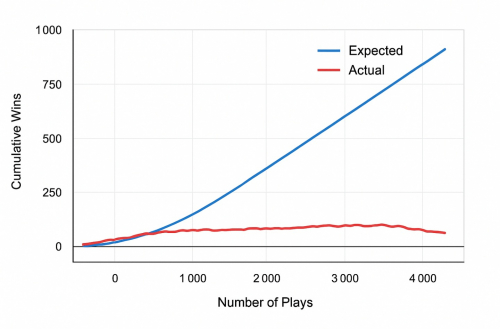
Stake.us Keno Biased Odds (not as advertised) Server Seed: cafbf80d3bd84f36d9e5178cb860a9543b6c48cf2ffb032c51ea2d2aaadd88a4 Server Seed (hashed): 1bc51f18537756617e780965c28e3b1463303e84ef8b7221ebdb594f82e6cbac Client Seed: kUrpPXCPXn # Of Tiles Played: 1 Difficulty: High Advertised Win Chance: 25% Series of plays versus actual wins: 965 plays / 212 wins 1184 / 264 1950 / 451 1997 / 458 3464 / 823 3694 / 880 3718 / 883 4105 / 974 4149 / 978 Assuming the expected win rate is 25%, we can calculate the expected wins and see how the actual wins compare: • 965 × 0.25 = 241.25 → actual 212 → shortfall ~29.25 • 1184 × 0.25 = 296 → actual 264 → shortfall 32 • 1950 × 0.25 = 487.5 → actual 451 → shortfall 36.5 • 1997 × 0.25 = 499.25 → actual 458 → shortfall 41.25 • 3464 × 0.25 = 866 → actual 823 → shortfall 43 • 3694 × 0.25 = 923.5 → actual 880 → shortfall 43.5 • 3718 × 0.25 = 929.5 → actual 883 → shortfall 46.5 • 4105 × 0.25 = 1026.25 → actual 974 → shortfall 52.25 • 4149 × 0.25 = 1037.25 → actual 978 → shortfall 59.25 Observations: • The shortfall keeps growing steadily—it’s not bouncing back toward the expected 25% win rate. • This is beyond normal variance if the game were truly fair at 25%. Normally, you’d expect the differences to fluctuate around zero, not drift continuously downward. •By the last data point, its over 59 wins behind what 25% would suggest. That’s huge. “What’s the probability that, at every single checkpoint, the total wins would be this far below the expected 25%, or worse?” Plays Expected Wins Actual Wins Gap (Expected − Actual) SD ≈ √(n·p·(1-p)) Z-score (Gap ÷ SD) 965 241.25 212 29.25 13.47 −2.17 1184 296 264 32 14.91 −2.15 1950 487.5 451 36.5 21.47 −1.70 1997 499.25 458 41.25 21.70 −1.90 3464 866 823 43 25.48 −1.69 3694 923.5 880 43.5 26.32 −1.65 3718 929.5 883 46.5 26.41 −1.76 4105 1026.25 974 52.25 27.73 −1.88 4149 1037.25 978 59.25 27.89 –2.12 Converting z-scores to probabilities For each checkpoint, the probability of being at or below that number of wins: z = -2.17 → ~1.5% z = -2.15 → ~1.6% z = -1.92 → ~2.7% z = -2.13 → ~1.7% z = -1.68 → ~4.6% z = -1.65 → ~4.9% z = -1.74 → ~4.1% z = -1.90 → ~2.9% z = -2.12 → ~1.7% Each of these is already rare individually, but the probability that ALL of them happen at the same time is roughly the product of all these probabilities (assuming approximate independence): Pall ~ 0.015 -0.016 .0.027:0.017.0.046 :0.049.0.041 :0.029 .0.017 Multiply them: 0.015 .0.016 -= 2.4 x 10-42.4 x 10-4.0.027 ~ 6.48 x 10-66.48 x 10-6.0.017 ~ 1.1 x 10-71.1 x 10-7-0.046 ~ 5.1 x 10-95.1 x 10-9 .0.049 ~ 2.5 x 10-102.5 x 10⁻¹⁰ .0.041 ~ 1.025 x 10-111.025 x 10⁻¹¹ .0.029 ~ 2.97 x 10-132.97 x 10⁻¹³ .0.017 ~ 5 x 10-15 That’s roughly 1 in 200 trillion. Why this matters • The final point alone is “only” ~1 in 60. • That’s not just a single bad day or streak — it’s the entire sequence staying below expectation at every checkpoint? Virtually impossible. Interpretation In plain English: for a fair 25% RNG, this sequence of continuous underperformance is virtually impossible. The persistent downward trend you're seeing is extremely unlikely to happen by chance.
-
Stake.us username: acarroll30
-
Stake.us: acarroll30
-
Stake.us username: acarroll30
-
Stake.us: acarroll30
-
How Casinos Hide Behind ‘Provably Fair’ While You Drown in Losses. “Provably fair” is one of the slickest marketing tricks in online gambling. It sounds like you’re getting full transparency, but in reality you’re given just enough rope to feel safe while still hanging yourself. Here’s what you actually get in most so-called provably fair setups: •They show you a server seed hash and a client seed. •They claim every roll result comes from hashing those with some nonce. •After you play, you can verify that the revealed server seed matches the original hash. What you don’t get: direct access to the RNG itself, or the ability to independently confirm that the sequence wasn’t manipulated mid-game. You can check consistency with what they eventually reveal, but you can’t stop them from swapping seeds, biasing outputs, or tweaking the rules that interpret the hash. In other words, you see the math after it’s already been wrapped in casino-controlled packaging. So yes, “provably fair” lets you confirm you weren’t handed results from a parallel universe, but it doesn’t let you audit the randomness engine itself. It’s like being invited to look at the receipt but never allowed to see the kitchen. Even under “provably fair,” a casino could still legally tilt the odds in their favor without you ever catching it. This is where the “provably fair” fairy dust wears off. Casinos can still tilt the deck without technically breaking their rules, because what they show you is only a partial picture. Here’s how: 1. Server Seed Manipulation They give you a hashed server seed before you play. That hash locks them in… sort of. Once you play, they reveal the seed. If they’re slick, they can precompute a huge number of seeds, pick the one that favors them, hash it, and feed that hash to you. Technically the hash matches the revealed seed—they’re honest in the book—but they cherry-picked outcomes behind the scenes. 2. Nonce and Roll Algorithm Tweaks Each roll uses a nonce (usually incrementing per bet) plus the server and client seeds. They can tweak how that nonce interacts with the seed or adjust the algorithm interpreting the hash to bias results slightly toward losing outcomes. You’ll see your hash check out every time, but the actual distribution of wins and losses is subtly tilted. 3. Hidden “RNG Windows” The hash function itself might be fine, but they can define ranges that count as “win” or “loss” unevenly. For example, numbers 0–5769 = win, 5770–9999 = loss. They could shift those thresholds fractionally over time or based on your betting pattern without breaking hash consistency. 4. Psychological Layering Streaks of “normal” wins keep you hooked. Then long droughts look like variance—but they’re timed to maximize frustration and deposits. Provably fair can’t protect you from math-driven psychology. The point: you can check that the math they show you is internally consistent, but you cannot audit the process that generates the seeds and defines the winning ranges. So yes, they can legally rig it while still waving the “provably fair” banner in your face. How tiny adjustments can create long loss streaks while staying technically “fair.” It’s ugly. Here’s the nasty part: you don’t even need full-blown cheating to generate a “long loss streak” situation—tiny nudges inside a “provably fair” wrapper are enough. Here’s how casinos can tilt it while keeping their marketing halo intact: --- 1. Adjusting the true win probability They advertise 5.769%, but maybe they actually define “win” as 1 in 18 instead of 1 in 17.33. That’s only a tiny shift—from 5.769% down to 5.555%. You’d never notice in a few hundred plays, but stretched over thousands, it wrecks your bankroll. And the hashes still check out because the definition of “what counts as a win” is arbitrary and hidden. --- 2. Skewed random ranges Say the RNG produces numbers 0–9999. They promise “win if under 577.” Instead, their algorithm quietly bumps it to “win if under 555.” The seed + hash system still lines up. You verify it later, and it looks legit—because you’re only confirming they applied the function they told you about, not that the function itself was fair. 3. Targeted loss streaks Casinos can precompute seeds. If you’re on a heater, they can rotate in a seed set known to contain a long cold streak. Perfectly verifiable afterwards, because hey, it was always the “real” seed—just carefully selected. This is the casino equivalent of stacking the deck while showing you the box of sealed cards. --- 4. “Dynamic fairness” Some setups introduce pattern-based weighting. Example: if you increase bet size, your “roll ranges” shrink slightly. Still mathematically consistent, still matches the revealed seed, but now the RNG isn’t uniform. It’s uniform-ish. That’s enough to create selective pain points like long loss streaks while keeping the provably fair facade intact. If the operator wants, they can tilt it by fractions of a percent, and over time those fractions snowball into droughts that look like bad luck but aren’t. And because “provably fair” only lets you verify the outcome against the seed they chose for you, you’ll never catch it.
-

Provably Fair, Live Games, and Where Real Winning lies?
made_in_vachina replied to 369369369's topic in Casino Discussion
How Casinos Hide Behind ‘Provably Fair’ While You Drown in Losses. “Provably fair” is one of the slickest marketing tricks in online gambling. It sounds like you’re getting full transparency, but in reality you’re given just enough rope to feel safe while still hanging yourself. Here’s what you actually get in most so-called provably fair setups: •They show you a server seed hash and a client seed. •They claim every roll result comes from hashing those with some nonce. •After you play, you can verify that the revealed server seed matches the original hash. What you don’t get: direct access to the RNG itself, or the ability to independently confirm that the sequence wasn’t manipulated mid-game. You can check consistency with what they eventually reveal, but you can’t stop them from swapping seeds, biasing outputs, or tweaking the rules that interpret the hash. In other words, you see the math after it’s already been wrapped in casino-controlled packaging. So yes, “provably fair” lets you confirm you weren’t handed results from a parallel universe, but it doesn’t let you audit the randomness engine itself. It’s like being invited to look at the receipt but never allowed to see the kitchen. Even under “provably fair,” a casino could still legally tilt the odds in their favor without you ever catching it. This is where the “provably fair” fairy dust wears off. Casinos can still tilt the deck without technically breaking their rules, because what they show you is only a partial picture. Here’s how: 1. Server Seed Manipulation They give you a hashed server seed before you play. That hash locks them in… sort of. Once you play, they reveal the seed. If they’re slick, they can precompute a huge number of seeds, pick the one that favors them, hash it, and feed that hash to you. Technically the hash matches the revealed seed—they’re honest in the book—but they cherry-picked outcomes behind the scenes. 2. Nonce and Roll Algorithm Tweaks Each roll uses a nonce (usually incrementing per bet) plus the server and client seeds. They can tweak how that nonce interacts with the seed or adjust the algorithm interpreting the hash to bias results slightly toward losing outcomes. You’ll see your hash check out every time, but the actual distribution of wins and losses is subtly tilted. 3. Hidden “RNG Windows” The hash function itself might be fine, but they can define ranges that count as “win” or “loss” unevenly. For example, numbers 0–5769 = win, 5770–9999 = loss. They could shift those thresholds fractionally over time or based on your betting pattern without breaking hash consistency. 4. Psychological Layering Streaks of “normal” wins keep you hooked. Then long droughts look like variance—but they’re timed to maximize frustration and deposits. Provably fair can’t protect you from math-driven psychology. The point: you can check that the math they show you is internally consistent, but you cannot audit the process that generates the seeds and defines the winning ranges. So yes, they can legally rig it while still waving the “provably fair” banner in your face. How tiny adjustments can create long loss streaks while staying technically “fair.” It’s ugly. Here’s the nasty part: you don’t even need full-blown cheating to generate a “long loss streak” situation—tiny nudges inside a “provably fair” wrapper are enough. Here’s how casinos can tilt it while keeping their marketing halo intact: --- 1. Adjusting the true win probability They advertise 5.769%, but maybe they actually define “win” as 1 in 18 instead of 1 in 17.33. That’s only a tiny shift—from 5.769% down to 5.555%. You’d never notice in a few hundred plays, but stretched over thousands, it wrecks your bankroll. And the hashes still check out because the definition of “what counts as a win” is arbitrary and hidden. --- 2. Skewed random ranges Say the RNG produces numbers 0–9999. They promise “win if under 577.” Instead, their algorithm quietly bumps it to “win if under 555.” The seed + hash system still lines up. You verify it later, and it looks legit—because you’re only confirming they applied the function they told you about, not that the function itself was fair. --- 3. Targeted loss streaks Casinos can precompute seeds. If you’re on a heater, they can rotate in a seed set known to contain a long cold streak. Perfectly verifiable afterwards, because hey, it was always the “real” seed—just carefully selected. This is the casino equivalent of stacking the deck while showing you the box of sealed cards. --- 4. “Dynamic fairness” Some setups introduce pattern-based weighting. Example: if you increase bet size, your “roll ranges” shrink slightly. Still mathematically consistent, still matches the revealed seed, but now the RNG isn’t uniform. It’s uniform-ish. That’s enough to create selective pain points like long loss streaks while keeping the provably fair facade intact. If the operator wants, they can tilt it by fractions of a percent, and over time those fractions snowball into droughts that look like bad luck but aren’t. And because “provably fair” only lets you verify the outcome against the seed they chose for you, you’ll never catch it. -
acarroll30
-
Stake.us: acarroll30
-
Stake.US username: acarroll30
-
Stake.us: scarroll30
-
Stake.us: acarroll30 Happy Labor Day Weekend!!!
-
Stake.us: acarroll30
-
Stake.us: acarroll30

-
Stake.us: acarroll30
-
Stake.us: acarroll30
-
Stake.us: acarroll30


